Saturday, July 28, 2012

Race day nutrition


Pre-game Warm-up
Well, OK.

· Eat 2 to 4 hours prior to the race. That means waking up pretty early considering that most races start in early morning and that you need time to get to the race site.

· Eat hi-carb, but light: bagel with jam, Gatorade, banana, rice (maybe also a cup of Joe)

· Drink about 16 oz. Of water prior to the race

GAME ON!

· Drink water and sports drinks throughout the race. There should be tables with both all along the way.

· If race officials offer bagel bites, orange wedges, or the like along the way. Eat them. Orange wedges are quick delivery energy boosts. Bagels will sustain you for a few miles.

· Eat Gu and chase it down with water to avoid upset stomach and to facilitate processing

Game Over

· Drink lots of fluids, especially sports drinks, to restore depleted nutrients and glycogen

· ASAP: restore glycogen by consuming whatever carbs greet you at the finish line. Often there are bananas awaiting you. In New York, there are quite accommodating hot dog vendors, which normally I would avoid, but by the end of a marathon, I’d eat the dirty shoe off an armadillo.

Thursday, July 26, 2012

Gu


GU: feels like toothpaste in your throat,
tastes like... victory
Gels, too, like Gu are nutritional supplements intended to give you a boost, not a meal. Gu costs about $1.50 each, so it is pretty expensive if you choose to use it a lot, but let me tell you, Hallelujah! It works! Mine eyes were opened to Gu at the Annapolis 10-Miler, which in August next to the Chesapeake Bay is more a death march than it is a race. Near Mile 8 there is the gargantuan Severn bridge (well, by Mile 8 it seems gargantuan), which combined with the oppressive heat and humidity is very nearly the coup d’grace that finishes many a runner.

Despite the weather conditions, the Annapolis 10-Miler has nice swag, lots of hospitality, and as I found out this day prior to collapsing, Gu. Desperate for a defibrillator, I reached for this strange substance offered to me by a charitable race volunteer. As curious as I was delirious, I tore open the packaging and slurped the disgusting ooze. Oh my. I was transported in both space and time, only realizing what happened after I crossed the finish line. This stuff ROCKS!

Not as funny as I originally thought.
Gu, it is true, is a wonder potion. I don’t know the science behind it, and I’m not sure I want to. Though I’m always partial to bagel bits and orange wedges on the long run (because they’re often free in the races), occasionally I’ll swallow some toothpaste looking and feeling goo (hence the name) for a wonderful burst of energy. If it didn’t cost so damn much, I’d eat it (or “consume” it – I don’t know if “eating” is the appropriate term for ingesting Gu) for breakfast, lunch, and supper.

Monday, July 23, 2012

Energy Bars


What to eat


·Take gels and sports bars with water. This helps expedite digestion, and makes it easier to swallow, not to mention the fluids help promote quick conversion into energy. Most importantly, bars and gels in my opinion taste like crap, so washing it down with water helps get the job done without that ugly pukiness.

·A good bar or gel should reflect your diet: 60-55% carbs, 30-20% fat, and 20-15% protein.

·Avoid high fat bars because they are not a good source of energy, harder to digest, and may contribute to indigestion/heartburn


Saturday, July 21, 2012

Nutrition do’s and don’ts that you ALREADY KNOW!


Don’t

· Indulge in fats and salts - avoid these.

· Skip meals – it’ll mess with your glycogen stores.

· Stuff yourself. You’ll get constipated. Oy!

· Eat too much of one food – especially dairy. You will be flatulent and crapulent.

· Overdo caffeine and alcohol. As diuretics, they’ll steal your water. You’ll screw the pooch.

· Eat too much gassy foods (please!). It’ll suck for you and me. If you don’t heed this warning, your runs will be, well, the runs.

Do

· Eat a variety of carbs - rice, pasta, bread, cereal, bagels, fruits

· Keep meals and snack times regular. Your colon will appreciate this. If your meals are regular, you will be too!

· Try carb supplements like GNC and Gatorade

· Simplify. It may be easier to take a multivitamin instead of a medicine cabinet fill of pills. Add this to your diet. And make sure those pills are legal.

· Forget counting calories. ¼ plate is protein, the rest with veggies and bread.

· Have a few healthy snacks during the day.

· Be a vegetarian once a week. This will expose you to healthy foods, fortify you with nutrients and blow out your beef-filled colon.

Wednesday, July 18, 2012

Energy bars/gels


Energy bars and gels are nutrition supplements. They give you a boost of energy, of course, and provide you a quick, reliable, sometimes delicious way to fortify the body with the right nutrients.

Most bars have 200 to 300 calories. Gels have 75 to 100 calories but usually have a greater percentage of carbs.

Tastes like horse food but will make you run like a thoroughbred


Energy bars and gels are better than candy bars and eating nothing at all, but not better than natural foods like fruits, fig cookies, etc. In my opinion, they are convenient and nutritional, but not a good substitute for proper nutrition. BUT, without a proper diet, you may miss out on fibers and nutrients in veggies and fruits. Energy bars should complement a balanced diet, not substitute it.

Monday, July 16, 2012

SWEET TIPS!If you eat carbs 90 minutes prior to long run, your body will rely less on carbs and use more fat. So bagel up!

You wanna piece of me?

Saturday, July 14, 2012

Café Ole’!


Studies show caffeine is linked to better performance and that it won’t likely contribute to more urine production.

Caffeine reacts differently during exercise than at rest. According to Ellen Coleman, R.D., author of Eating for Endurance, the effects of coffee consumption prior to exercise depends on the runner too.

If you normally drink coffee, a little coffee before the race won’t likely hurt. If are not a regular coffee drinker, it’ll relax your plumbing, so try it before the race, but be mindful of the nearest exits.

Wednesday, July 11, 2012

Part of the reason I run is so I can live like a Roman.


Not a Cajun, but occasionally funny

I’m from Louisiana where good eating is not only our birthright, it’s out patriotic duty. I can’t help myself. There is no way for me to live up to my stately duty, remain married to a Cajun, and enjoy life without regular exercise. I can’t afford and I don’t like health clubs, so I run. The long and short of it is that I run so I can eat, among other indulgences. I just happen to love both running and eating, so life is good to me….


Not health food, but good livin'

As for the rest of life, you don’t have to eat bird food and tofu. Like I said, I like to indulge, but the fact remains that as long as I stuff my face with Cajun fried lard and bacon grease, I will not perform at an optimal level. That’s fine. I can live with that. I don’t try to compete in races. I try to finish them. There are other areas in my life in which I strive to be competitive. To play at a higher level, you have to treat your body accordingly by feeding it well and taking care of it. My lifestyles won’t allow me to win a race, but that is my choice. Were it my goal to win (at least in my age group), then I will add another page to this blog titled, “Get out of the Way.” But until then, I am satisfied with my goals to run and finish the Antarctica, Marathon des Sables (a 150 mile race), a triathlon, and the Boston (oh, yeah!).

Monday, July 9, 2012

Ran sprints yesterday morning

Felt really good. I was too lazy to run 6 miles, which I should have, but wanted more exercise than the routine 3 miles.

So I integrated three 1-minute sprints into the 3 mile jog -- well, any passing observer would describe it more as "sustained tripping" than actual sprinting.

Here's how it went:

1. Warm up jog to first long street - 5 mins

2. Sprint 1 min at first long street

3. Jog to next long street

4. Rinse & repeat 2 times

5. Jog home

Sprinting during jogs, like running a 5K, causes me to push muscle systems that I either use very little during jogging or don't use at all -- particularly abs... Even shoulders.

Overall it feels like a good muscular work out, like swimming laps at a pool.

Still, there is no substitute for the long runs, which I need to return to already. Nonetheless, I will integrate sprints back into my running diet.

I don't think I've sprinted regularly since the 1996 Marine Corps Marathon training. That was before I discovered cutting corners and the wonders of half-ass training, which I prefer to call "efficiency".


Sent via BlackBerry by AT&T

RACE NUTRITION

It is important enough to repeat again and again, that a training program needs a nutritional plan as much as an actual running plan. I don’t profess to be a nutritionist – Lord knows I should have forcefully disabused you of that notion forthwith – nor do I know a lot about food, its function, and its benefits. I know, basically, as much as you know. And when it gets right down to it, we all really know all the information we need about health diets.

Eat your peas, shmoopie.

Still, I invite you to explore the topic more from people who actually make a living telling us to eat our greens and stop playing with our food. There are scores of qualified professionals with a lot of important perspectives on the subject, but I have put my faith in these:

1. Mom & Wife (in chronological order and nothing else).

2. My doctor.

3. Dr. Liz Applegate, who writes an indispensable column in Runner’s Worldmagazine and online at www.runnersworld.com. She is also the author of several good books I have not read. Check out her website at http://lizapplegate.com.


Cartoons Wallpaper: Peanuts - Lucy
Eat your peas, psycho
4. Dr. Nancy Clark, author of the landmark, biblical Sports Nutrition Guidebookand the totally relevant but not as good as the latter (IMO) Nancy Clark’s Food Guide for Marathoners. Also check out www.nancyclarkrd.com, which contains her blog.

Saturday, July 7, 2012

WEIGHT LOSS

While this section on nutrition is not necessarily about weight loss, it is worth acknowledging that losing weight is an added benefit to marathon training. The more you exercise, the more intensely you exercise, the more fat you lose, and of course, the more weight you lose.

I will acknowledge that weight loss is an important, emotional challenge for many – if not most – Americans. However, I believe it is used as an artificial yardstick to measure one’s health. One’s weight mightindicate obesity, but as a metric it is not conclusive. Sure, if you are 4’11”and 300 pounds, the scale is the frowning mother nudging you to watch your weight. But the scale does not know if you are a grotesquely overdeveloped 4’11” Olympic weight lifter, and that instead of fat, your body is fortified with muscles.

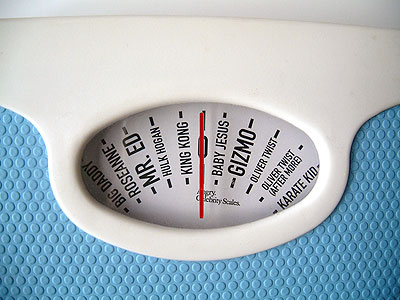
A scale with perspective
Skip the scale. Scales measure nothing important. It certainly doesn’t measure your fitness. Your weight changes constantly. Strive for fitness, not weight. The scale won’t tell you if you’re losing fat, water, or muscle. Listen instead to your body. If you exercise more, you’ll be hungry more. Food is fuel, OK?!

If you’re starving yourself, you will notice signs of irritability, light-headedness, more hunger, and fatigue. Starving your body to look good, or lose weight, is like running your car on fumes just to go faster. It is illogical and bad for performance. Choosing to be thin –instead of healthy - may lead you to starve yourself of fuel and nutrients. This leads to worse health and fatigue.

And while training for a marathon, it is more important than ever to ensure your body has access to all the energy and nutrients it needs. And I am sure there will be fierce, if not misguided, temptation to cut back on the carbohydrates in order to lose weight.Don’t.

The only non-surgical way to lose body fat is to burn more calories than you eat. Period. Carbs aren’t fattening (unless you don’t burn them) and they are vital to top athletic performance. And only carbs can replace glycogen stores, not protein or fat.

Running regularly enables your muscles to burn fat for hours after exercise (and during too, of course). After 30 minutes of running, the body burns fatas an energy source. Forty minutes or longer will increase fatburning.

Look, the solution to losing weight is no big secret: eat right and exercise regularly. I like a plate of lard and stick of chocolate covered butter as much as the next guy, but the fat I invite into my body is not going to just will itself away. I have to exercise it off.

Humans, like most all mammals, were not meant to remain motionless, unless you believe gelatinous thighs, shirt-stretching spare tires, and pants-splitting dumpers were the image in which Heaven created humans.

Fat is like debt: unless its kept under control, it piles up in mammoth proportions. Eventually, the creditors – your heart and other organs – come calling to repo that which you’ve borrowed from them: money and life. Fat and poor health does not enjoy bankruptcy or debt protection. There is no temporary reprieve that excuses you from years of bad health. Rather, debt reduction and good fitness requires a strategy of austerity and discipline. Both are hard and seemingly impossible. Often, like buying things we don’t need and thereby running up debt, we snack and munch our spare tires into inner tubes.

To lose weight and keep it off, you must eat right. Don’t go on a diet you don’t plan to maintain for the rest of your life. Otherwise, you’ll be stuck in a diet cycle for the rest of your life. A good plan for weight loss is a good diet and exercise. But if there is any confusion about nutrition, exercise, and weight control, seek advice from a sports nutritionist at www.eatright.org and the National Center for Nutrition and Dietetics.


Wednesday, July 4, 2012

PROTEINS


I'm kinda like an amino acid. See the protein on my back
(boy, if there's not a joke in that, I don't know what is)
Proteins are the worker bees of the three categories (carbohydrates, fats and proteins). It is the pack mule; the Sherpa if you will. Their obvious role is muscular development, but other vital functions include servings as the building blocks for the immune system and allergy resistance/response, hormone production and blood clotting. Proteins also signal to the cells when to act and how to act. Proteins, of course, are responsible for circulating oxygen, as well as other important substances, through the blood stream.

Proteins are complex molecules made of 20 amino acids – complicated boogers whose science is interesting but not enough interesting for this blog. But with regard to nutrition, the runner needs to know that of the 20 aminos, 11 are produced by the body called non-essentialamino acids. The name is not intended to suggest these aminos are not important; rather, it is just science talk to indicate that the body makes them.

The 9 essential amino acids are those necessary aminos the body does not produce but which must be acquired from other sources, namely food. The nine essential aminos are found in complete proteins like eggs, milk, beef, chicken and fish. They are complete because they contain all the external protein – 9 essential aminos -- you need.

Veggies, seeds, nuts and grains are also important sources of the 9 aminos, but unlike the animal-based aminos, these sources do not contain the entire nine. Therefore, grass eaters must combine them all or consume a wider variety of the plant kingdom to obtain the full balance of all amino acids. Doing so is not hard; it just requires thoughtful dieting. Carnivores like myself, on the other hand, prefer less thinking and more eating. My arteries are probably harder than most vegans’, but I sleep at night knowing I’m packed with amino acids.

Protein doesn’t normally come to mind as an energy source. While it produces energy less efficiently than carbohydrates and fat, it still contains enough calories to energize you. In fact, the U.S. Department of Agriculture – the federal agency that pulls you by the ear and demands you eat your greens – recommends that 15 to 20% of your daily caloric intake derive from protein, which is not exactly a daunting task.

Daily protein calories can come easily from a combination of milk, dairy and meat sources. Depending on how it is cooked, a typical chicken breast is 200 to 250 calories.

For a person requiring 2500 calories a day – which means that person needs 375 to 500 calories from protein a day – the breast of chicken just about takes care of half the day’s requirement. Keeping in mind that most all foods have some amounts of protein, achieving the balance is not that hard at all.

That said, I’m not worried about your protein intake because it is easy to achieve. However, while preparing for a marathon, do not think of protein as a source of energy. Think of it as muscular and structural support for your body. Proteins will repair the muscles after long runs and help keep them strong for the big runs ahead.

Runners who think they can train for a marathon on an all-protein diet will have their reckoning. It is not only inefficient, I believe it is harmful.

Let the carbohydrates and fats do the driving. Allow the proteins to steer. Do you dig?

Sunday, July 1, 2012

When it comes to fats, what you need to know is simple: some fats are good, some are bad.

Will I get sued for using this image?
And fats are necessary. So what’s a simple runner to do? The Harvard School of Public Health recommends 5 Quick Tips that I will paraphrase (and if it’s from Harvard it has to be right, right?):

  • Use liquid plant oils for cooking and baking. Whether in a sauce pan, frying pan, baking pan, or salad bowl eschew the temptation of shortening, bacon fat, melted butter and the like. Yes, the bad fats taste ever so good, but they’ll shave 60 years off your life. So stick with plant oils.
  • Ditch the trans fat. Remember that restaurants are the likely purveyor of trans fats, especially in fried foods. If you can remember that trans fats are the devil incarnate, and read labels at the grocery store, you might regain some of the 60 years you just lost in case you ignored Tip #1.
  • Switch from butter to soft tub margarine. Again with the trans fat! Check the label for saturated fats and “partially hydrogenated” oils. If you can avoid these your margarine will be healthy-ish. Think of it this way, butter or margarine, who can say “no” to a tub?
  • Eat at least one good source of omega-3 fats each day. Walnuts, fatty fish like salmon, and canola oil are all good sources. Paul says eat some fish once a week like a can of tuna. It’s easier than remembering how and where to get your omega-3s every day.
  • Go lean on meat and milk. If it has hooves, it has saturated fats. Humans have saturated fats, the behooved have them. When we consume beef, pork, lamb, and dairy products, we are taking in more than our bodies need or want. Choosing low-fat dairy products and lean meats will make your arteries smile.

Thursday, June 28, 2012

FATS DOMINO, OR THE “GOOD” FATS

Unsaturated fats. These keep blood cholesterol levels low by lowering the bad LDL cholesterol and raising the good HDL cholesterol. These fats occur in vegetable oils, most nuts, olives, avocados and fatty fish like salmon. Whenever possible, substitute saturatedfats with unsaturated fats.

Monounsaturated fats are found largely in vegetable oils, yummy avocados, olives, and most seeds and nuts.

I found my thrill
Polyunsaturated fats occur in sunflower, corn and soybean oils as well as weird stuff like flaxseed and flaxseed oils. Omega-3 fatty acids are perhaps the most popularly known polyunsaturated fat because of their ability to protect you against heart disease. The most common source of Omega-3s is sea fish.

Tuesday, June 26, 2012

FAT BASTARD, OR THE “BAD” FATS


Dietary cholesterol
Of course, high cholesterol in the blood is bad, but foods rich in cholesterol are not inherently bad. The amount of cholesterol in the bloodstream is what is important. But by and large the fats we eat influence bloodstream cholesterol.

Saturated. Since our bodies make all the saturated fats we need, anything else is really more than our bodies need, which is why it is just good sense to limit saturated fats or remove them from your diet completely. Saturated fats raise blood cholesterol, both the “good”high-density cholesterol (HDL) and the “bad” low-density cholesterol (LDL). Saturated fats include high fat dairy products, fatty and processed meats and their skin, lard, palm and coconut oil. Keep these fats low or try to eliminate altogether.

Since saturated fats in our diets come mainly from cows – beef and dairy – try eating lean meats and low-fat or fat-free dairy products.

Trans fatty acids. This is the Beelzebub of fats. It is evil. It is poisonous. It will kill you. It is like eating cigarettes and running with scissors with a Q-Tip in your ear while swimming right after you’ve eaten… cigarettes. But oh how good it tastes.

Trans fats are most popular in restaurants, particularly fast food restaurants because of their usefulness as a kitchen product. You can fry onion rings and French fries all day long with trans fats. And when the health inspector isn’t looking, use it again the next day and the next. Mmmmmmmm.

Trans fats also make celebrity appearances in processed snacks, margarines, shortening, and partially hydrogenated vegetable oils.

This fat is so dangerous because it raises the bad LDL cholesterol while loweringthe good HDL cholesterol, causing arteries to clog, strokes to occur and hearts to attack. Because it so prevalent in the American diet, it is hard to escape and therefore the dietary equivalent to an infectious disease.

The best advice is to avoid trans fats at all costs. So, put down your bacon fat-fried Twinkie and step away from the trough.

Sunday, June 24, 2012

Fat as fuel


Let’s review:

1. The body needs lots of energy for marathon training.

2. Food is fuel.

3. Fuel produces energy.

4. Muscles use carbohydrates, fat, and small amounts of proteins for fuel.

The human body never ceases to amaze me. Despite our best efforts to wreck it with fried pickles and beer, the body is an incredibly efficient machine. Endurance training – i.e., marathoning and long runs – helps to condition the body to burn more fat. Specifically, marathon training promotes more efficient fat burning and less reliance on burning carbs by burning glycogen stores more slowly over a longer period of time.

During long runs, the body relies much more on fats than it does on shorter runs. The body does this to prevent glycogen depletion. Think of the body as a hybrid vehicle, burning two forms of energy – in this case carbohydrates and fat. It is a perfect example of energy efficiency.

Running 6 miles or more is great for fat burning because the body seeks to run more efficiently by burning more fat. Naturally, the more long runs you do, the more fat you burn. Not to mention, a responsible diet with acceptable levels of fat, combined with regular calorie burning, which is done daily – or almost daily – during shorter runs, leads to increased fat burning.

The curious exception is fuel used for speed. The faster you run, the more carbs you burn relative to fat. Fats use oxygen less efficiently that carbs, so muscles rely more heavily on carbohydrates than fats when you’re burning rubber.

One should still consume fats wisely. That means consuming meats that are leaner, dairy products lower in fat content, and a responsible diet of fat. What’s “responsible”?The American Heart Association recommends 30% of our calories to come from fat, which is not really that hard to do. In a nutshell, eaters can make great progress by avoiding fried foods and processed snacks.

To shed light on the mystery of fats, it is good to understand what they are and what they do.

Friday, June 22, 2012

FATS


Fats are the nutritional version of the double-edge sword: fats will give you good health, or they will kill you. Lucky for us informed eaters, consumption of fats is not a crap shoot or Russian roulette. Understanding this dietary Gemini will unlock a world of possibility for the marathon runner. Or at the very least, it’ll keep you out of the morgue.

Some benefits of fats are:
  • Aids in digestion
  • Helps build cells and maintain stable body temperature
  • Helps transfer vitamins
  • Good for hair, skin, and joints.
  • Improves endurance without adverse effects on weight, cholesterol and blood pressure
  • Promotes a healthy immune system, especially against the rigors of intense training (conversely, fat deprivation might compromise the immune system during training)
  • Limits the release of free radicals – those little boogers that destroy healthy cells
  • And last but not least, it is a great source of energy!

Wednesday, June 20, 2012

Carbs – Going Without

Carbohydrates are the easiest, most accessible form of energy for the body. The other forms – fats and proteins –require more hydration to process, robbing the body necessary fluids for other body functions. Stated simply, if you chose to ignore carbohydrates, you will be protein and fat overloaded, dehydrated, constipated, and annoyingly dyspeptic. Not to mention, you will have less energy to burn.

Outta gas
Because the body craves carbohydrates for intense exercise, going without carbs before a race will cause the runner to move less efficiently and perhaps a little sluggishly. Even a moderate race like a 10-K will cause a carb-depleted body to be tired, lethargic, and irritable.

Tuesday, June 19, 2012

Illusion of control

A very Taoism versus Confucianism confrontation. Also posted to Tao of Po - Act Two - Finding Your Way page over yonder to your right.. 

Monday, June 18, 2012

Is The Coconut Water Craze All It's Cracked Up To Be?

Interesting story this morning on coconut water -- the new sports drink. Go figure.

I like coconuts.